
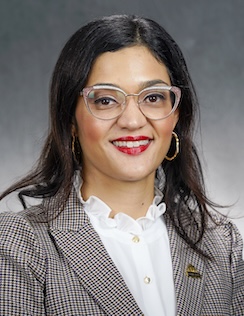
On October 30, Eyes Off Saint Paul conducted an interview via video with Maria Isa Pérez Vega, candidate for the open seat on the Ramsey County board of supervisors. Pérez Vega is currently serving as a representative in the Minnesota house. Transcript follows.
Eyes Off: 00:20
Again, thanks for taking the time.
Perez Vega:: 00:24
Absolutely, thank you, guys. Really.
Eyes Off: 00:26
Busy calendar, I see.
Pérez Vega 00:28
Very busy. Couple days off here, and I’m trying to keep my immune system as strong as possible.
Eyes Off: 00:34
Oh yeah. How long have we set aside this morning? How long do we have?
Perez Vega: 00:41
I was informed 15 minutes.
Eyes Off: 00:44
Okay, we better dive in.
Perez Vega: 00:47
Okay.
Eyes Off: 00:49
First, could you talk about your personal opinion on the need for, role, and scope, of surveillance technologies used by law enforcement?
Perez Vega: 01:09
Representative Maria Isa Perez Vega, two-term DFL Minnesota House Legislator representing the capital city of Saint Paul as well as the suburb of West Saint Paul in two counties of Ramsey as well as Dakota County.
So, having experience in leadership as a legislator working with four different departments between the local police department of SPPD and West Saint Paul Police Department, as well as Ramsey County Sheriff’s Department and the Dakota County Sheriff’s Department. Aside from that, local capital security, which sits in my district, as well as our state troopers, I’ve had conversations regarding my experiences as being a young woman of color growing up being surveilled due to my work in community organizing and activism, due to the intense police violence that I have been a victim in community of before even knowing what the word activism meant as a child, and bringing those lived experiences into what does surveillance overall mean for our overall safety, and what’s keeping us safe, and what are those relationships being built from the actual public, the actual people, and how that engages with the leaders of law enforcement and these individual departments.
My work as a legislator has been able to give me the opportunities to have a phone call of you know let’s let’s phone a friend right let’s get engaged into this house research of the data implementing where surveillance and technology is now, and how different it has played from the lack of technology modernization in the ’80s to where we’re at now, where we can surveil from our own phones, let alone our own watches on our wrist.
This is very important to me, not only as somebody that has feared my own safety because of the injustices of police violence, it’s also a matter of how do we keep our community safe with the new technology. I learned a lot of the implementation of data security and what is lacking therefor of when I was the one of the lead authors for our driver’s licenses for all to provide public safety initiatives and and civil rights for our undocumented community to have a driver’s license.
A big part of my role was to protect and ensure that the data for undocumented communities was protected by the state and not leaking to federal ICE agents, our federal administration of immigration law enforcement. And that was something that I battled for till the very end in my first month of being a legislator because the negotiations brought forth of the table were that we, on the other side of the aisle, was that we were not going to be able to pass it unless we pushed to have the data being released. And that was something I fought very hard for because of my own lived experiences and as well as my community upbringing with being raised with an immigrant community and family members, we know, and as a daughter of a Young Lord of the Puerto Rican social organization out of New York City, our families have been followed and been surveilled just for fighting for human rights.
So a large part of my role has been on advocating for strong restrictions and accountability for governments’ uses of surveillance and technologies, protecting residents and overseeing a public oversight of surveillance and transparency when these negotiations, whether it is Flock, whether it is you know, there’s so many of them. I get a little frustrated when people think that it’s just the flock when there’s so many different, it’s like Coke and Pepsi products, and what is the sponsor of those data collection agencies?
But you know, my focus has been working with the leads in the state departments of Public Safety to ensuring that technology doesn’t disproportionately threaten our communities that are being surveilled. But there’s also these, you know, what are the pros? What are the cons? And the pros in some of those advocacy where we are hoping that the data isn’t leaked, right? But is, for example a woman named Kari who was killed in broad daylight while she was painting a mural in my Lowertown community of District 65B, and she was shot and killed in the back of her head with no conscious of somebody doing that.
And it was a surveillance camera that detected the license plate and found the the suspect who had ended up having a shootout with the state troopers and the police department, and he was located about two hours away. So we know that if we did not have access to that technology, we wouldn’t have found the killer. But that technology. If that’s the pro, what are the cons, right? And the cons are that there’s a lot of these same technology usages of cameras that are not protecting and our most vulnerable populations.
Eyes Off: 07:03
So, at the county level, if you were to win election as a commissioner, would you work to ban the use of mass surveillance technology such as Flock, Axon, Skydio, or do you think regulating them is sufficient? If that can be drawn carefully enough and and adhered to, and what sort of safeguards are there? What’s the fallback if the entities being regulated go past those guardrails?
Perez Vega: 07:44
I mean, there’s a consistent fight within my office now on overall surveillance, and I’ve been a co-author of our House version of Representative Brad Tabke on more regulations and safeguards against the misuse of these practices, of these these surveillance technologies. As well as have deep partnerships and conversations with Clare Oumou Verbeten in regards to how local departments, you know, we were fighting for that at the state. Our members on the other side of the aisle did not want to comply, moving it forward.
And as a county commissioner, I will continue to advocate in opposing the uses of these surveillance cameras. There’s a step one to step two is having more conversations regarding the outside agencies and unauthorized parties that have been leaking our information, and how there needs to be proactivity on holding them accountable for those past tactics and how they may have continued other efforts in other forms. You know, the number one role of a leader is to make sure that you are protecting your constituents and protecting the constitutional rights and our civil liberties and our individual privacy, so I definitely will be continuing that advocacy to dismantle those contracts.
Eyes Off: 09:14
Thanks. Next question: How would you preemptively address and dissuade future end runs around the elected officials by private entities like Flock, et cetera, from directly engaging with law enforcement to install the technology?
Perez Vega: 09:48
I mean, there needs to be you know innovation that comes with accountability. There also needs to be a not only within elected officials but the community outreach and making sure that they have the transparency and privacy just as much as us as elected officials and politicians.
Our role in government is to protect, right? Our role as advocating for ordinances and legislation that is to protect our freedoms should be highly valued by those that are in law enforcement, and so my role is to have these safeguards against what’s been misused.
And the safeguard isn’t just starting with the technology; it’s starting with each individual that has been very pro of these these technologies, and also may not understand like the accessibility that is actually out there due to other resources at the hands of our own children that are studying coding in school. So the overall, it can’t just be made up of a a sheriff or a chief’s advisory.
It really has to come from the overall experiences of what technology has been connected to in our modern day lifestyle. You know, we all have iPhones. We’re on this computer right now. You’re recording this. How do we 100% know that this is securely strongly oversighted, right? by allowing our safety of what we’re even using now. So I think that there is a need for more protection and more leadership amongst our our legislators, our local electeds, our overall levels of government right now, especially what we’re dealing with, especially what we’re dealing with this federal administration that is going haywire on targeting us. And as somebody who’s been a survivor of political violence in the last year, it’s really highly enclosed that we don’t want to let go of things that can protect us, but we also have to see what we’re compromising because that’s not safe either.
Eyes Off: 12:29
What role should the public play in giving their consent for AI-enabled mass surveillance?
Perez Vega: 12:38
The role of the public should be the priority in creating these ordinances and policies.
It’s a strength that I’m somebody — that majority of my work in policy is before I became a legislator and a lawmaker. It was, you know, we the people are to create the policy with those who are going to fight for it. So the advocacy of ensuring that there is consistent organizing work and spaces of usage within our own government bodies to ensure that there is consistent meetings.
But meetings are one thing, but you need to take action, and the action comes with the public, the action is really there. The stories, the testimony. That’s why I always get a little frustrated with the the capacity of sometimes people just stop fighting for it. And I’m like, you have to. If we don’t fight for it with the people and listen and have our public engaged in actually creating the policy with us as makers, then we shouldn’t be in leadership.
We can talk about it, we can say we’re about it, but I’m one that has been consistent with taking action and holding accountability to other colleagues as well as myself. You know, we’re not perfect people, but we have to listen to the people that elect us. That’s our job. The public is my boss, so if I’m not including what they deserve, what is the necessity for the overall public, you know, oversight of the surveillance, then I’m really not doing my job. And I want to be a continuous voice for the people as an elected. So they are definitely the priority in creating this policy to remove these technology that are abusing our livelihood.
Eyes Off: 14:53
Organizations like Flock and Axon deploy coaching to law enforcement to so-called “own the narrative.” Do you have any reactions to that practice of these companies and law enforcement, and how would you react to that in office?
Perez Vega: 15:12
Completely, completely, just absurd… the reality of that is actual and it is factual. I get a little emotional because of the realities of what I have faced, and also the beauty of being able to be a change maker in working with law enforcement and informing them of the harm and the damage due to the trainings that they have. Like, you get a badge for going through a program, but how come the public don’t have access to that same badge to give constructive criticism to?
And so I am someone that wants to continue to create and pass legislation at the local level because of these issues that I’ve had oversight at the state. You know when there’s these budgets of $3 million for capital security that usually just gets channeled and funneled to the St. Paul Police Department without an oversight of the fiscal note, the budget. I came into office and said, absolutely not. I want to see every dang dime that’s being spent and what it’s being used. If this is about community safety and outreach, I don’t see any community organization involved in this. And if we’re talking about interacting with children and youth and families around our capital city and our capital complex, I want to meet with not just the SPPD. I want to meet with every leader of law enforcement. I want our Ramsey County Sheriff’s Department here. I want our Capitol Security here. I want our state troopers here because these dollars amounts fund their tactics and their training.
And if we don’t have accessibility to knowing what their training is, but they’re allowed to kill on camera and get away with it, like what we’ve seen with people that are near and dear with me, such as Philando Castile and George Floyd. And we’re now looking at the federal administration taking abusive powers of doing the same thing that our state and local PDs have been doing. We’ve got to make sure that the training is accessible for us to comment to make sure that there’s policy that is going to be constructive in holding accountability and also changing the ways that our law enforcements are trained.
Eyes Off: 17:36
What does oversight of these programs look like at the county level? So, in your dream world, who participates in oversight? How is it communicated with the public? What recourse is available when the programs run afoul of the oversight?
Perez Vega: 17:57
Oversight should be a variety of not only the law enforcement that I’ve already stated, that should be the people that are listening. But the first and foremost should be the appointment of community leaders that are engaged in our schools, that are at our places of worship, that are our business owners, that are the everyday moms and dads at the park, and most importantly, the youth.
You know, when you leave our children out of the policy to keep us safe, that’s unsafe. And that’s also [what] we are seeing in the large amounts of our opiate crisis and our gun violence and crime levels. So the county has departments that work that I’ve been able to partner at the state with, like our Ramsey County Youth Workforce initiatives, as well as our youth that have been incarcerated, that have been my students through Ramsey County Juvenile Detention Center, and also adults that have been a part of the prison system. We can’t exclude folks that have done their time for their crime.
And we also have to include the people that are the health and peacemakers in there. I think about our worship leadership that are are fearing, you know, with the targets of religious beliefs happening in our mosques and in our temples and in our places of worship, and that inclusivity is what the county is there to do. The county has a billion dollar overall annual budget, and if more is going to fuel guns and cameras, we’re losing the connection here of what the county is actually to do is to serve the people that are most vulnerable, who need access to food and need access to housing, which provides opportunities for less surveillance when you’re engaged in the community. So a very big point is making sure that those community leaders are involved, and it’s not just: who does the commissioner think is a buddy and working in this? It’s listening to the actual organizations that are doing the work.
When there was a shooting that happened at a funeral reception of something that happened on the east side. The Neighborhood House is on the west side community. There is a gang violent murder that happened, and they brought the funeral to the Wellstone Center. No one knew of this community because it was the East Side community, but they felt that it would be safer. It was not safe because gun violence happened in retaliation by two different gangs that were not from our community.
Now, if people in our law enforcement were including community leadership like the West Side Boosters, like the West Side Community Organization, even the Capital Community Commons, Ramsey County Sheriffs that work with these organizations. If they had been advised of this, there would have been a right of way to say no. This funeral should be hosted at on the East Side, in community, and also should have community leaders with law enforcement at the place of worship and the funeral, so that this wouldn’t have taken place. But there was a lack of surveillance, even with surveillance being a camera. There was a lack of engagement of human beings, and that’s what we need to continue to support, and that’s what I would be supporting as the next Ramsey County Commissioner.
Eyes Off: 21:27
Great. In terms of getting contracts for these kinds of technologies signed and reviewed, where does the buck stop? Who has the final authority? Is that the county commissioners, the sheriff? Who?
Perez Vega: 21:45
I mean, it comes about the board of the county commissioners. The sheriffs are proposing what they want to be as it’s filled within the ordinance. He doesn’t get to to write the ordinance. Our seven board county commissioners have the conversations as well as what does the statute of the Constitution of the state of Minnesota have? What leverage do we have in our local governments, and what needs to be addressed to be changed or be more of statute to apply these measures of just the override of surveillance technology and how they’re being held in dispute and what are the restrictions and how are they being operated?
So it’s really the joint partnership of all levels. But the county board is the one who gets to decide that. The sheriff, if they decide the sheriff’s department to go against what the county board is leveraging on. Well, that’s why elections matter, and that’s why folks need to get more engaged on who are actually leading these efforts and pushing these contracts. Right? They definitely get a budget, but just like in the city, the county, local government, they approve the. It is the board. It is the councils that approve the overall budget for our public safety department. So it’s not to say, oh, the sheriff did this and I didn’t know that they spent this money. Well, they have to. So then you have to hold the sheriff’s department accountable if that wasn’t listed in what you passed as an overall budget on the agenda that you gavelled on.
Eyes Off: 23:31
Last question, unless we have some follow-ups. What are good ways for us, the public in general, to bring input or advice to the attention of council members at the county level?
Perez Vega: 23:48
I think what your organization has been doing has been really great in connecting with folks that are elected officials. You know, I had conversations with my colleague and supporter of my candidacy for Ramsey County Commissioner, and who I call the chair of our St. Paul delegation’s public safety committee, Athena Hollins, Representative Athena Hollins, because she sits on that committee, and a lot of what I’ve been able to push as a lead for the no-knock warrants has been through her advocacy as a lawyer and attorney who sits on that committee to make sure that our communities, all of our communities, becoming as a woman of color who has witnessed such violence and abuse due to the police officers that are not doing their job to serve and protect, we’ve been able to be successful in our trifecta.
And also having conversations on the other side of the aisle as a legislator. These are partnerships that I have built as a legislator that are going to continue when I’m at the county because you’re going to need that support. You’re going to need that advice. I don’t know everything, but I do know from my lived experiences and I do know from the curriculums that I’ve been able to build on those kids who have been incarcerated. And how they come back into their everyday life that isn’t all sugarcoats and rainbows.
So you know, the very implementation is to make sure that they are organizations that are being supported as well, not just being listened to, but what are funds of the county that can partner with groups and conversations to be consistent with these meetings because they cost money. Technology for people to pay their phones to be able to look and follow you on Instagram costs the regular person who may be you know feeling the detrimental injustices of police surveillances.
So you know I want to be able to continue to do that as I have been in different ways, in creative ways. I think about how we have an arts community and how arts has played a pivotal role of communication with these organizations. Whether it’s on our public safety, whether it’s on SNAP and food nutrition, mutual aid and healthcare, these are the opportunities at the local level that should be consistent, especially in local government that isn’t [run] on a part-time session schedule, but is a full-time session.
Eyes Off: 26:08
Okay, one more question for me. This one’s kind of specific. St. Paul asked that flock cameras be removed from the city, and the police department followed that, and the sheriff did not. Would you push to get the county cameras out of St. Paul?
Perez Vega: 26:31
I’ve already been trying to, and I was very vocal about it when this is something that has been on my radar before it was a headline in everybody’s news, or when it came a headline for our city, this is something that I’ve been working on for quite a long time before I was an elected, just because of the massive surveillance and the technology. I’m also a record producer. I used to record on film, and now you know we have digital, and we can record on our phones and have a Grammy Award-winning or nominated song, all right?
So I’ve been advocating for that, and I’m going to continue to fight for it at the county level with these conversations that need to happen and are challenging. But if you are too scared to grab the bull by the horns, then we’re going to see a consistent pattern of folks only vocalizing things to politicize it during an election year.
Eyes Off: 27:41
Okay. Well, thanks so much for taking the time to join us and answer our questions.
Perez Vega: 27:46
Absolutely. I hope you have a wonderful rest of your weekend. Gracias.
Eyes Off: 27:54
Thank you. Good day.